

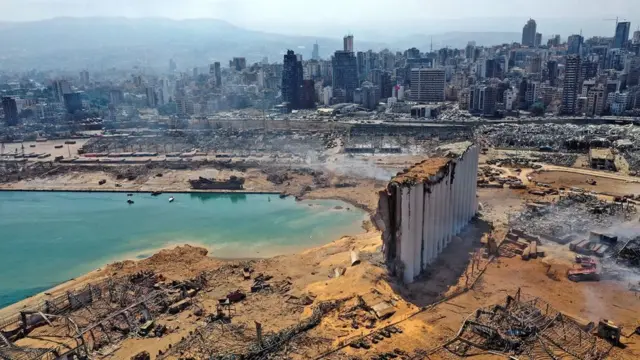
Today marks five years since the tragedy of the Beirut Port explosion, which left more than 220 people dead and 6,500 injured. The disaster was caused by a fire in a warehouse where tons of ammonium nitrate, commonly used as fertilizer, had been stored.
On this occasion, Lebanese President Joseph Aoun said on Monday that the Lebanese state is "committed to uncovering the full truth, no matter the obstacles."
He noted that, according to media reports, the materials that caused the explosion were offloaded at the Port of Beirut in 2014, after having been en route to Mozambique, due to a mechanical failure and the owner's failure to pay the required fees.
However, he believes that these materials were intended for the Syrian regime, with the support of Hezbollah, which held influence over the port’s administration.
Fadi Sawan, the first judge assigned to the investigation in 2020, resigned after bringing charges against former Prime Minister Hassan Diab and three former ministers.
The independent judge, Tarek Bitar, resumed the investigation but was forced to suspend it in January 2023 after facing hostility from a large segment of the political class, especially Hezbollah, which questioned his impartiality before he was tried on charges of contempt.
He was able to resume his investigations in early 2025 after President Aoun and his Prime Minister took office, promising to uphold the independence of the judiciary following the war between Israel and Hezbollah, which severely weakened the Shiite movement last fall.
Mr. Imad Al-Zawahira attributes this five-year-long obstruction of the investigation to "pressure from Hezbollah" and "the Syrian regime and its allies aligned with Hezbollah."
“They put all their weight behind preventing the indictment from being issued and allowing matters to slip away,” he said.
As for the ruling states in the Middle East—such as the United States, Israel, other Western countries, and Turkey—he described this as a “blackmail tactic.”
These countries exerted pressure to issue the indictment “whenever there was a conflict with Iran, and withdrew when there was alignment.”
“The political bargaining took place both within Lebanon’s internal affairs and on the regional level,” according to him.
He said Hezbollah “is not a single entity; it is a system that includes Lebanese politicians who are Christian and Sunni.”
He added that “the entire Lebanese political class that had, in some way, a relationship with Hezbollah during the past period has benefited from the failure of the investigation [so far].”
Weakening Hezbollah
In his remarks, Imad Al-Zawahira explained that Hezbollah, which is facing significant pressure following the "military defeat it suffered," will not agree to surrender its weapons "except with guarantees."
Among the proposed guarantees is its transformation into a political party, which may not succeed because, as he said, “the ideology he follows is not acceptable.”
He can "surrender his weapons to the Lebanese state and transform into a political party. And God forgive what has passed, because Hezbollah is deeply involved in Lebanese bloodshed, such as the assassination of Hariri, the bombings, and other incidents in Lebanon and even in Syria."
Mr. Al-Zawahira believes that Hezbollah has entered a “phase of decline.” He stated that the recent blows it has suffered have led to “its retreat from the Iranian project, which is originally a nationalist project.”

